May 27, 2026Device & Behavioral Intelligence
Best Device Intelligence Solutions and Platforms in 2026



Device fraud has a structural problem: most identity checks happen once, at onboarding. After that, the account is treated as verified – and fraudsters exploit this gap. Account takeover, multi-accounting, emulator-based abuse, and synthetic identity attacks all succeed because the device layer goes unmonitored after sign-up.
Device intelligence addresses this directly. By analyzing behavioral, technical, and network signals at the device level – continuously, not just at registration – it creates a persistent risk profile that static KYC checks cannot replicate.
This article covers 12 leading device intelligence solutions and platforms, evaluated on signal depth, privacy architecture, market coverage, and fit for specific use cases.
Device fingerprinting is the foundation. It generates a persistent, unique identifier from browser or hardware attributes – user-agent strings, screen resolution, installed fonts, hardware configuration, and similar parameters that remain stable across sessions. The core question it answers: have we seen this device before? That's a powerful capability – something no KYC check can replicate. It may help link repeat devices across sessions or after some client-side resets, though results depend on implementation, platform, and available signals.
Most of the vendors in this article started as device fingerprinting providers. Some still use "device fingerprinting" and "device intelligence" interchangeably in their own marketing. If you're searching for the best device fingerprinting solutions or providers, you're largely looking at the same competitive set covered here.
Device intelligence is what you build on top of fingerprinting. It layers behavioral analytics, network anomaly detection, environment signals (virtual machine use, emulator detection, DOM manipulation), and risk scoring on top of the device ID. The result isn't just "known or unknown device" – it's a risk vector that feeds directly into fraud decisions and credit scoring models.
The difference has practical consequences. A device fingerprint tells you a device is new. Device intelligence tells you whether that new device is running inside a virtual machine, using a residential proxy, exhibiting automation patterns, and sharing behavioral signatures with 40 previously flagged accounts. Fingerprinting is the identification layer; intelligence is the risk layer built on top of it.
Before comparing individual vendors, it helps to have a consistent framework. These are the dimensions that separate strong solutions from adequate ones.

JuicyScore is a device intelligence and risk scoring service built around a set of aggregated risk indices – each representing a scoring model for a specific risk domain, from fraud pattern detection to credit risk assessment. These indices are derived from 65,000+ device-level parameters and produce 230+ predictive signals used directly in both fraud prevention and credit scoring models.
Operating across 45+ countries, the solution is built around technical device and behavioral signals rather than identity enrichment such as email, phone, or social data.
At the technical core sits JuicyDeviceID – a probabilistic device identification model built to return a single stable identifier across different browsers and private browsing modes on the same physical device. This closes a well-known gap in the category: solutions that rely heavily on browser- or session-level hashes tend to fragment into multiple identifiers when users switch browsers or when fraudsters deliberately use private modes and anti-detection tooling to splinter their digital footprint. Cross-browser normalization and probabilistic session linking across thousands of device and environment signals keep the identifier stable even when individual signals change.
The service goes beyond device identification to produce a long vector of aggregated risk attributes – VM detection, behavioral anomalies, IPv6 risk indicators, remote access tool detection, and more – that clients integrate directly into their internal scoring models. This makes JuicyScore a data provider as much as a fraud tool: lenders and banks use the signal vector to improve both fraud detection and credit underwriting simultaneously.
One signal category worth noting separately: DOM injection detection. JuicyScore identifies client-side page manipulation after load – a fraud vector not always covered in standard device fingerprinting stacks. For financial services, where malicious scripts injected into the browser can alter form data or intercept credentials before submission, this is a meaningful layer of coverage that sits outside the standard device fingerprinting stack.
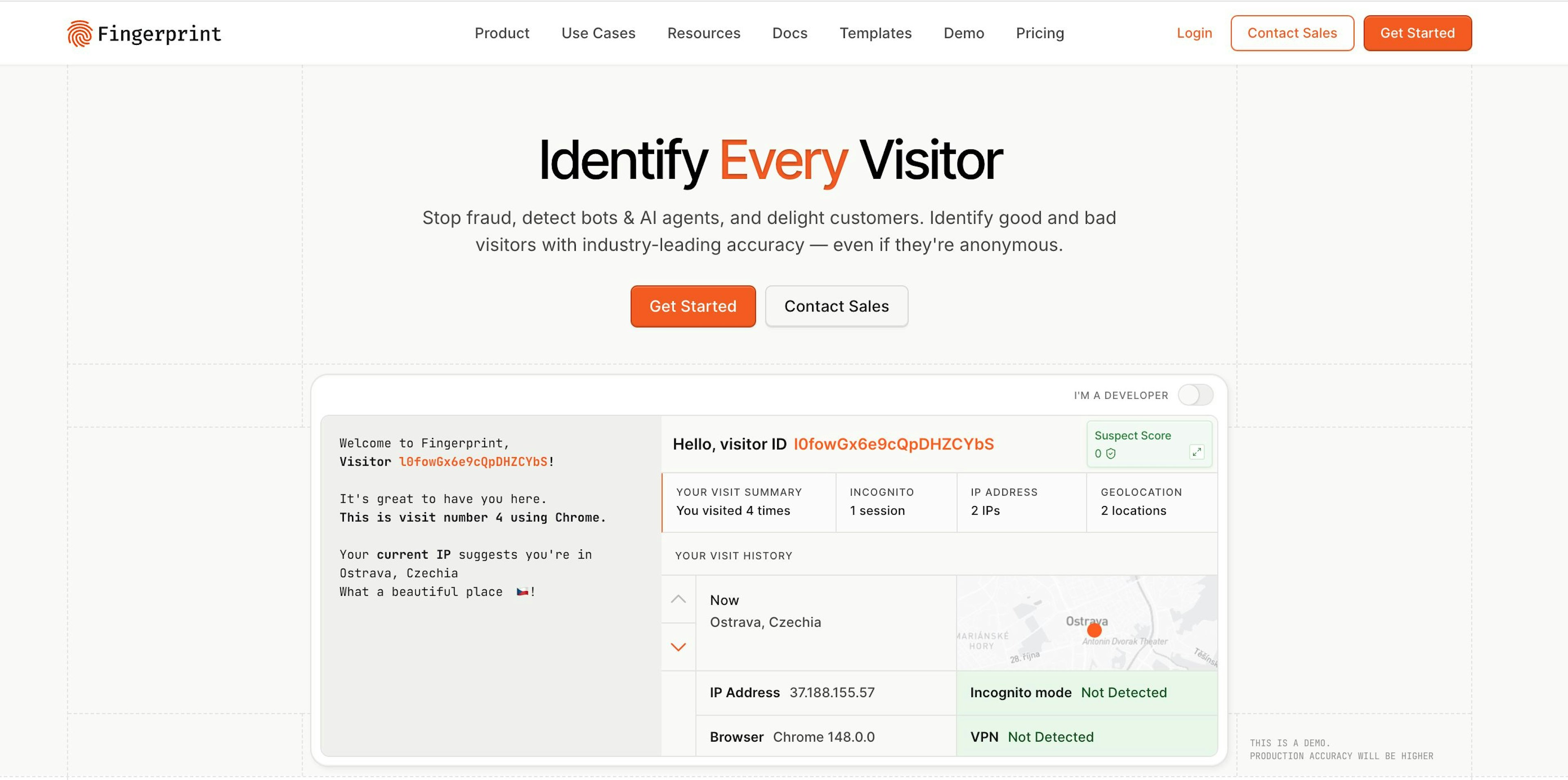
Fingerprint is a developer-first device identification platform that uses 100+ signals to assign a persistent visitor ID across browser sessions. Its Smart Signals suite extends identification into bot detection, VPN and proxy detection, incognito mode detection, emulator and VM detection, and geolocation spoofing detection.
The platform's architecture prioritizes accuracy on visitor identification – its core claim is industry-leading fingerprint persistence. It's deliberately modular: teams that want raw identification data and plan to build their own risk logic on top of it will find it a strong fit. Teams looking for a complete fraud prevention stack will need to combine it with additional tools.
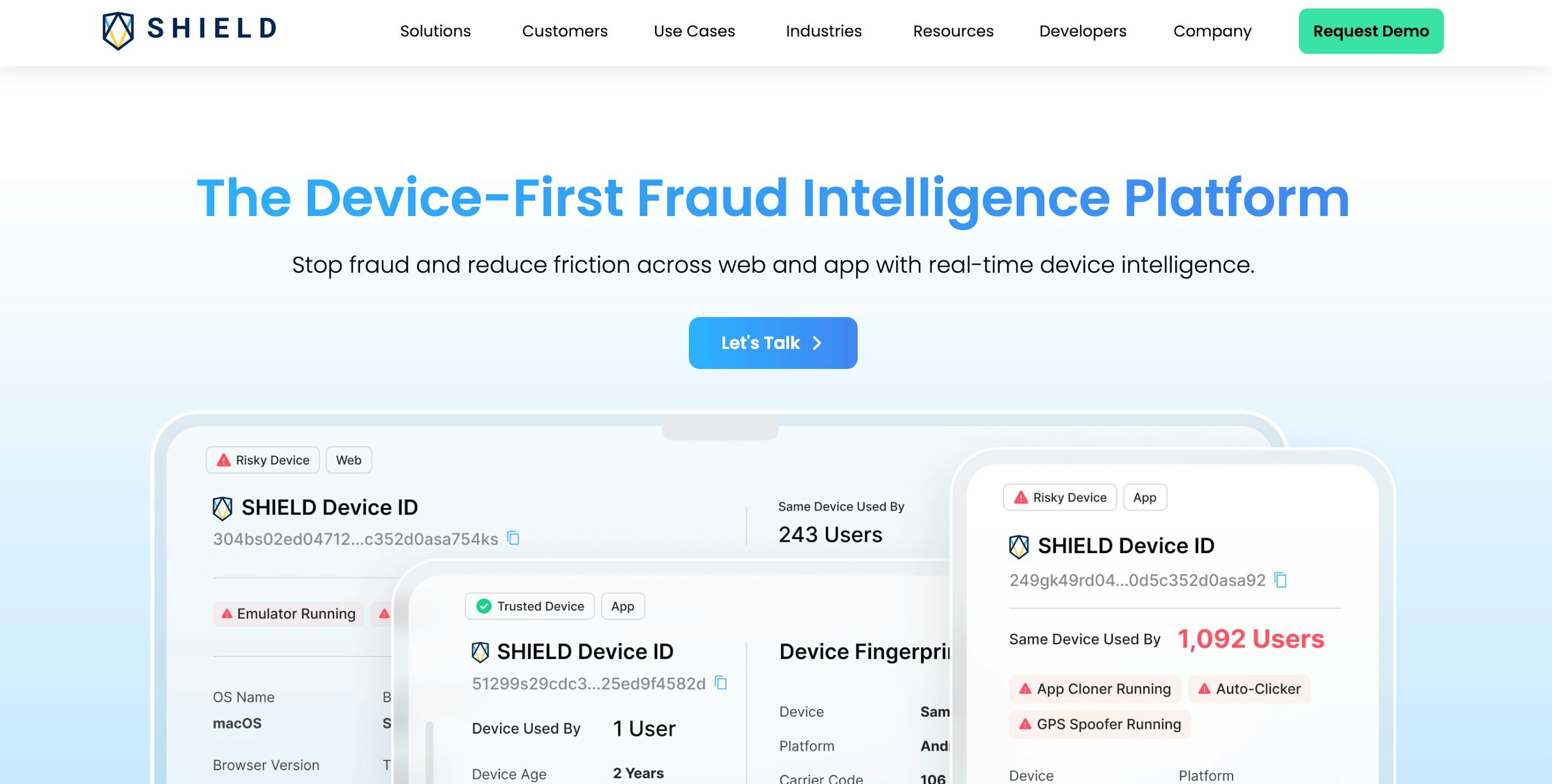
SHIELD (formerly CashShield) is a Singapore-headquartered, mobile-first device intelligence platform that combines device ID with behavioral analytics to detect fraud on Android and iOS applications. Its client base is concentrated in Asia-Pacific – with customers including inDrive, Alibaba, Swiggy, Meesho, and TrueMoney – though the company has expanded globally with offices in San Francisco, London, Berlin, Jakarta, Bengaluru, and Beijing.
The platform's behavioral modeling approach is built around mobile-native patterns – GPS spoofing, app cloning, root/jailbreak detection – making it particularly effective for mobile-first markets where fraud vectors differ significantly from web-based attacks.
Best for: Mobile-first platforms – ride-hailing, food delivery, e-wallets, neobanks, streaming, marketplaces – particularly those with significant APAC user bases.
Key differentiator: Deep mobile behavioral analytics; persistent device identification that survives reinstalls and factory resets.
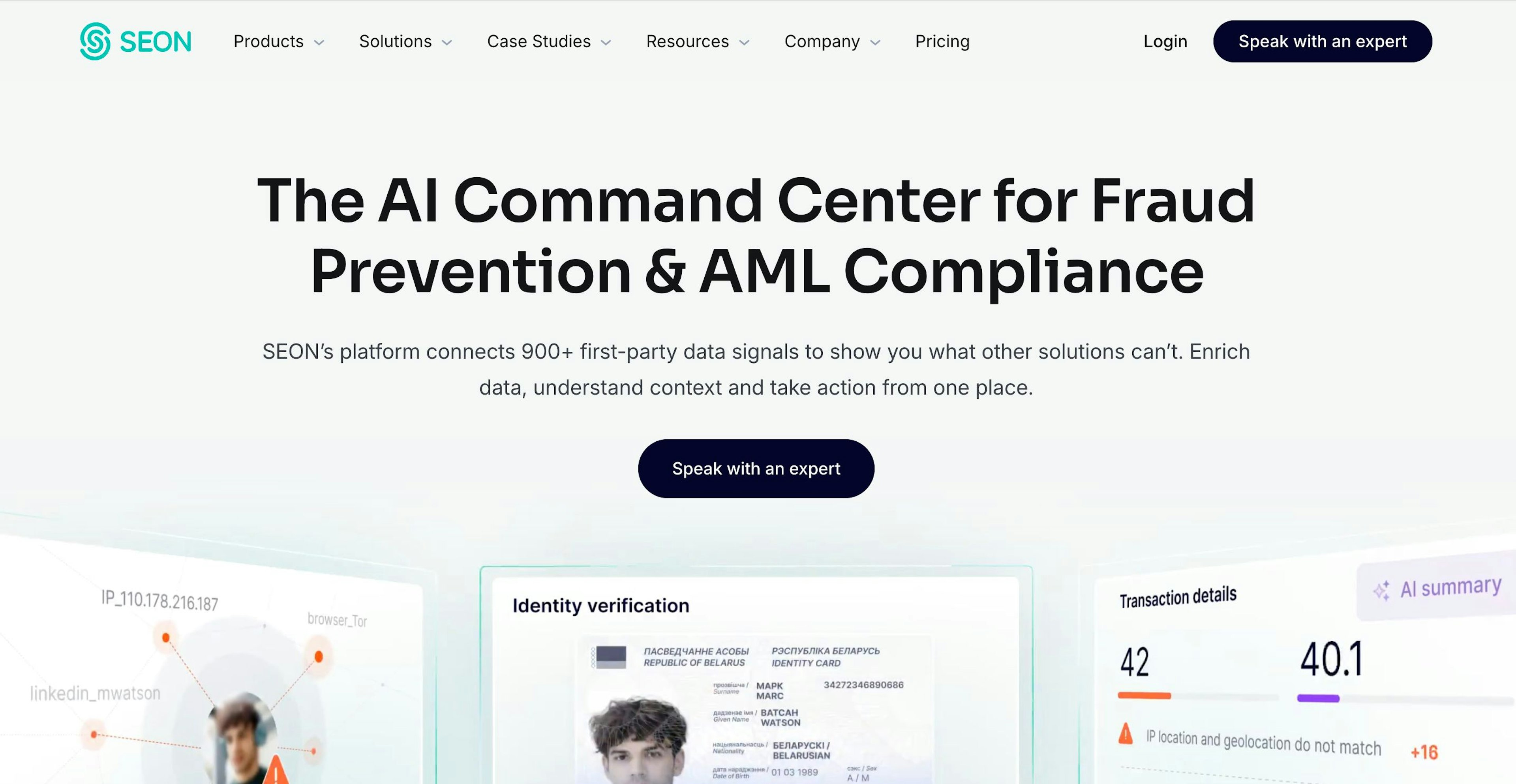
SEON combines device fingerprinting with broader digital footprint analysis – email risk signals, phone intelligence, IP reputation, and social media enrichment – into a single compliance and fraud platform. AML screening and case management are part of the stack, making it closer to a compliance platform than a pure device intelligence tool.
Its transparent decisioning model, where risk factors are visible and adjustable, appeals to compliance-heavy teams that need to explain rejections or escalations to regulators or internal audit functions.

TrustDecision is an AI-driven fraud prevention platform with strong roots in Asia-Pacific financial services. It combines device intelligence with behavioral biometrics, network analysis, and alternative data signals, targeting the fraud patterns common in digital lending, BNPL, and online payments in high-growth markets.
The platform's model is designed for high transaction velocity environments where manual review is not viable – its decisioning is built to operate at scale with minimal latency.
Kount is a trust and safety platform acquired by Equifax in 2021, which gives its device intelligence a direct link to Equifax's credit identity data network. This integration distinguishes it from pure-play device intelligence vendors: Kount can correlate device signals with credit history, identity verification, and chargeback history in ways that standalone tools cannot.
Its fraud decisioning is AI-based, and it includes native chargeback defense capabilities – useful for merchants for whom payment disputes are a primary fraud cost.

ThreatMetrix is one of the oldest and most established names in device intelligence (the original product was founded in 2005), now operating as part of LexisNexis Risk Solutions following its 2018 acquisition by parent company RELX. Its central asset is the LexisNexis Digital Identity Network – a consortium that aggregates anonymized device and behavior signals across thousands of participating organizations, enabling real-time threat intelligence based on collective exposure.
For large financial institutions, the network effect is the primary value proposition: when a device or identity appears fraudulent anywhere in the network, that signal propagates to all connected clients immediately. The platform also integrates with LexisNexis's broader risk data products, including identity verification and adverse media screening.
iOvation was one of the original device reputation networks – one of the first services to offer device-based fraud prevention at scale. It was acquired by TransUnion in 2018 and has since been integrated into TransUnion's broader fraud prevention portfolio as TruValidate.
The transition means iOvation's device reputation database is now part of a larger identity and risk data stack, giving organizations the option to combine device signals with TransUnion credit data, identity verification, and fraud analytics. For organizations evaluating the market, iOvation's historical position means its device reputation network carries significant depth.

Sift is a digital trust and safety platform that uses device signals as one input into a broader behavioral model focused on user actions rather than devices alone. Its "Sift Score" is built from device data, behavioral patterns, transaction history, and network signals, making it particularly useful for platforms where the fraud risk is tied to what users do rather than solely which device they're using. The platform draws on a global data network reported at over a trillion events annually.
Sift is widely used in e-commerce, marketplace, and gig economy contexts where account abuse, promo fraud, and seller/buyer fraud require action-level monitoring rather than just session-level signals.

GBG (GB Group plc) is a UK-headquartered, publicly listed identity intelligence and fraud prevention company (founded 1989, listed on the London Stock Exchange) with a substantial footprint across financial services, telco, iGaming, and government-adjacent markets in EMEA and APAC. Identity verification is the company's primary positioning, with device signals contributing to its fraud and onboarding stack alongside document verification, address verification, and mobile intelligence (including SIM swap detection).
GBG's strength is in markets where identity data infrastructure is relatively mature and where compliance requirements are closely tied to KYC and onboarding – making it a natural fit for banks and financial services firms that want to unify identity, address, and device-related risk signals in a single vendor relationship.
Sardine is a full-stack fraud and compliance platform serving banks, fintechs, neobanks, payment companies, and merchants. It combines device intelligence with behavioral biometrics, AML and sanctions screening, and AI-based risk process automation – covering the full compliance lifecycle rather than just the device risk layer. Major banks now sit alongside fintechs and merchants in its customer base, and the platform reports profiling billions of devices through its Sonar consortium.
The product is calibrated for the high-velocity patterns common in modern financial services: account funding fraud, ACH and wire fraud, sophisticated scams, high-velocity transaction abuse, and cross-border payment risk.

Incognia takes a location-first approach to device intelligence. Rather than relying primarily on hardware and browser signals, it builds persistent device identity by learning the unique location pattern of each device over time – home, work, regular routes. Unusual location behavior (or inconsistency between stated and actual location) becomes the primary fraud signal. The core product, Incognia ID, combines this location intelligence with device identity and app integrity signals.
This approach is effective across both location-sensitive verticals (gig economy, food delivery, P2P marketplaces, ride-sharing) and mobile banking and fintech, where location consistency is a meaningful signal for ATO prevention and new-account fraud.
The right device intelligence solution depends on your vertical, geography, and what you're actually trying to prevent.
Digital lending and microfinance in emerging markets: Signal depth, PII-free architecture, and compliance with local data protection laws are non-negotiable. JuicyScore and TrustDecision are built specifically for this context. ThreatMetrix and Kount are often evaluated by larger enterprises that already operate within LexisNexis, Equifax or similar identity-data ecosystems.
E-commerce and retail: Chargeback defense, bot detection, and promo abuse prevention matter most. Kount, Sift, and Fingerprint are strong contenders depending on whether you need device-layer precision or broader behavioral context.
Crypto and neobanks: Full-stack compliance alongside device signals is usually required. Sardine and SEON cover both fraud and regulatory requirements in one platform.
Mobile-first markets: SHIELD's mobile behavioral analytics are purpose-built for this environment, with strong presence in APAC. Incognia is worth evaluating if GPS spoofing is a significant attack vector or location consistency is a meaningful trust signal.
Large financial institutions: ThreatMetrix's consortium intelligence network and Kount's Equifax integration provide depth that pure-play device tools don't match.
| Vendor | Platform type | Best fit | Main angle |
|---|---|---|---|
| JuicyScore | Device intelligence: antifraud & risk scoring | Teams that need device and behavioral risk signals for fraud and credit decisions | 65,000+ non-personal device data points and 250+ signals |
| Fingerprint | Device intelligence / visitor ID | Teams that need persistent visitor identification and device-level Smart Signals | Visitor ID plus Smart Signals for suspicious browser/device configurations |
| SHIELD | Device identification & intelligence | Teams focused on fake accounts, device abuse and device-level fraud | Device fingerprinting, device identification and fraud intelligence |
| SEON | Fraud prevention + AML platform | Teams that need fraud, identity and AML signals in one platform | 1,100+ first-party signals across digital footprint, email, phone, IP and device |
| TrustDecision | AI fraud prevention + credit scoring | Finance, lending, BNPL, ecommerce, mobility and gaming use cases | Device intelligence, behavioral patterns and alternative data for fraud and risk scoring |
| Kount / Equifax | Identity & fraud services | Teams looking for identity, fraud and orchestration capabilities | Real-time fraud and identity insights within the Equifax/Kount ecosystem |
| ThreatMetrix / LexisNexis | Digital identity intelligence network | Teams that need digital identity risk assessment at scale | Digital identity intelligence combining device, location, behavior and historical risk patterns |
| TransUnion TruValidate / iOvation | Identity, device and behavioral insights | Teams evaluating device risk as part of broader identity and fraud mitigation | Device Risk, IP Intelligence, Email/Phone Verification and Device-Based Authentication |
| Sift | Fraud prevention + risk-based authentication | Digital businesses managing ATO, payment fraud and first-party abuse | Global data network and real-time fraud decisioning |
| GBG | Identity verification + fraud prevention | Teams that need identity, location and fraud data intelligence | Identity verification, location validation and fraud prevention solutions |
| Sardine | Fraud, AML and transaction monitoring platform | Banks, merchants and fintechs fighting financial crime | Fraud prevention, AML compliance and real-time transaction monitoring in one platform |
| Incognia | Mobile device + location intelligence | Teams where mobile device trust and location signals matter | Device signals combined with location intelligence and tamper detection |
Disclaimer. This comparison is based solely on publicly available information, including vendors' official websites, product pages, documentation, and publicly available technical descriptions. All comparisons are made in good faith based on how each vendor describes its own functionality and how we describe our own product.
Product capabilities, positioning, and availability may change over time, and the most suitable solution will depend on your integration requirements, risk strategy, and specific use cases.
Information about the vendors included in this comparison is based on publicly available sources as of September 2026.
Device fingerprinting generates a unique device identifier from browser or hardware attributes. Device intelligence goes further – it layers behavioral signals, network anomaly detection, environment analysis (virtual machines, emulators, automation frameworks), and risk scoring on top of that identifier, producing actionable risk output rather than just a device ID.
It depends on the solution's architecture. Solutions that operate without processing PII – analyzing only technical device parameters – carry a structural compliance advantage across GDPR, India's DPDP Act, Brazil's LGPD, and similar frameworks. Solutions that link device data to personal identity require more careful compliance implementation and may require user consent in certain jurisdictions.
Leading solutions analyze anywhere from 100 to 65,000+ device-level parameters. Depth matters because sophisticated fraud tools actively probe for shallow signal sets and evade them. A solution analyzing a broad parameter set is harder to spoof than one relying on a handful of browser attributes.
Yes. Strong device intelligence solutions identify VMs and emulators by checking for hardware inconsistencies, missing sensors, and abnormal driver configurations that real devices don't exhibit. This is a critical signal category for financial services fraud, where emulator-based multi-accounting is a common attack pattern.
No – they address different problems. KYC verifies identity at onboarding. Device intelligence monitors the device continuously across the account lifecycle. The combination provides coverage that neither approach achieves alone: according to Sumsub's 2024 Identity Fraud Report, approximately 76% of fraud attempts now occur after the KYC process – during ongoing user activity – which is precisely the gap device intelligence is designed to close.
Vendor descriptions are based on publicly available information as of 2026, except where noted. The JuicyScore section reflects first-party product detail; all other summaries rely on publicly available sources. Capabilities change – verify current details directly with each vendor before making procurement decisions.

Device spoofing quietly weakens fraud prevention and credit models. Learn how spoofed devices work and how lenders can detect them with device intelligence.


Explore how device intelligence improves fraud detection, credit scoring, and onboarding – with real-time analysis and privacy-first design.

Virtualized fraud is gaining ground. Discover how early detection of emulated environments can protect your portfolio and streamline decisioning.

Get a live session with our specialist who will show how your business can detect fraud attempts in real time.
Learn how unique device fingerprints help you link returning users and separate real customers from fraudsters.
Get insights into the main fraud tactics targeting your market — and see how to block them.
Phone:+971 50 371 9151
Email:sales@juicyscore.ai


Our dedicated experts will reach out to you promptly
 Why device intelligence