September 30, 2026Fraud Prevention
Ecommerce Fraud Prevention Software: 14 Fraud Detection Providers Compared in 2026


 What to look for in ecommerce fraud detection softwareThe 14 ecommerce fraud prevention software providersChargeback management and guaranteeTransaction monitoring and risk decisioningDevice and behavioral intelligenceBot and automation detectionComparison by approachHow to choose the best solution for your storeTakeawaysSubscribe to the JuicyScore newsletterFAQ
Ecommerce fraud prevention software, also known as ecommerce fraud detection software, detects and blocks fraudulent orders, accounts, and chargebacks across the customer journey, using signals such as device data, behavior, and transaction patterns to separate genuine customers from fraudsters. The market splits into four broad categories – chargeback management and guarantee, transaction monitoring and decisioning, device and behavioral intelligence, and bot detection – and most merchants combine more than one.
Fraud reaches every stage of the online journey and quietly erodes margin through chargebacks, account takeover, promo abuse, and false declines. The MRC's 2026 Global eCommerce Payments and Fraud Report found that 3.2% of total annual ecommerce revenue globally is lost to payment fraud, and global ecommerce fraud losses are projected to reach $107 billion by 2029.
Choosing the right software is harder than it looks, and not for lack of options. The market is crowded with tools that describe themselves in nearly identical language – real-time, AI-powered, frictionless. This guide groups 14 providers by category, explains what each one does, sets them side by side, and shows how to choose by both fraud type and business size. For how ecommerce fraud works and the prevention practices behind these tool categories, see our companion guide to ecommerce fraud prevention.
Before comparing vendors, it helps to have a consistent framework. These dimensions separate a strong fit from an adequate one.
Fraud appears at signup, login, checkout, fulfillment, and refunds. A tool that only screens payment misses account takeover, promo abuse, and return fraud. Map where you actually lose money before you shortlist.
Which data layers does the tool analyze – payment, device, behavioral, network, identity – and does it read them in combination? Correlation across signals separates real risk from noise better than any single check – the shift from isolated signals to a structured risk layer that a growing number of risk teams now treat as system-level context.
A tool that blocks fraud aggressively but rejects good customers can cost more than the fraud it stops – by some industry estimates, several times more. Ask how each vendor measures and minimizes false positives, not only how much fraud it catches.
Assess the SDK and API surface, the payment-processor and platform integrations on offer, and response time under load. For checkout, latency should be measured in milliseconds, and detection has to hold up during peak-season traffic.
Does the tool process personally identifiable information, or work on technical signals only? Solutions that assess risk without relying on direct user identifiers can simplify a merchant's data posture under frameworks like the GDPR, India's DPDP Act, and Brazil's LGPD.
Compare per-transaction, revenue-share, and subscription pricing against your transaction mix and margins. The right tool should reduce chargebacks and manual review enough to pay for itself.
The tools below are grouped to show the range of the market, not ranked against one another. Most merchants combine several categories, and the right stack depends on risk profile, volume, and existing systems.
The note on the list: vendors are grouped by primary category and described from publicly available positioning. This is not a feature audit or a ranking.
This category tracks, disputes, and analyzes chargebacks to recover funds and expose patterns. Some vendors add a guarantee that reimburses approved orders that later prove fraudulent, shifting liability off the merchant. It's one of the most widely adopted categories, since chargebacks are often the first and most visible fraud cost – global chargeback volume is projected to rise sharply, by MasterCard estimates to 337 million by 2026, with first-party ("friendly") fraud the leading dispute type.
1. Signifyd
Oriented toward order screening and chargeback protection, with a guarantee that shifts fraud liability on approved orders. Uses machine learning and a large commerce network to automate approve-or-decline decisions and lift approval rates.
2. Riskified

Chargeback-backed guarantees for large ecommerce merchants, using machine learning trained on historical order patterns to lift approval rates while covering approved fraudulent orders. Extends into policy-abuse prevention and adaptive checkout friction.

Combines automated decisioning with a large team of fraud analysts for a human-in-the-loop model, designed to rescue legitimate orders that automated systems might decline. Offers an optional chargeback guarantee and strong ecommerce-platform integrations.
Wyllo blends checkout fraud screening with post-purchase and returns risk intelligence, aiming to cover the commerce lifecycle from checkout through refunds and support. It retains the automated-plus-review model and easy deployment on Shopify, BigCommerce, and WooCommerce.
These tools screen activity in real time, aggregate signals into a single risk decision, and trigger step-up checks when risk crosses a threshold. Some extend into full-journey decisioning, and this category includes several of the largest enterprise platforms in the market.
5. Bureau ID

An AI-powered unified risk decisioning tool that combines device, identity, behavioral, network, and transaction signals into a single decision, aiming to cover fraud beyond checkout – fake accounts, promo abuse, account takeover, and delivery risk among them. No-code workflows let fraud teams adjust policies without heavy engineering.
6. Sift
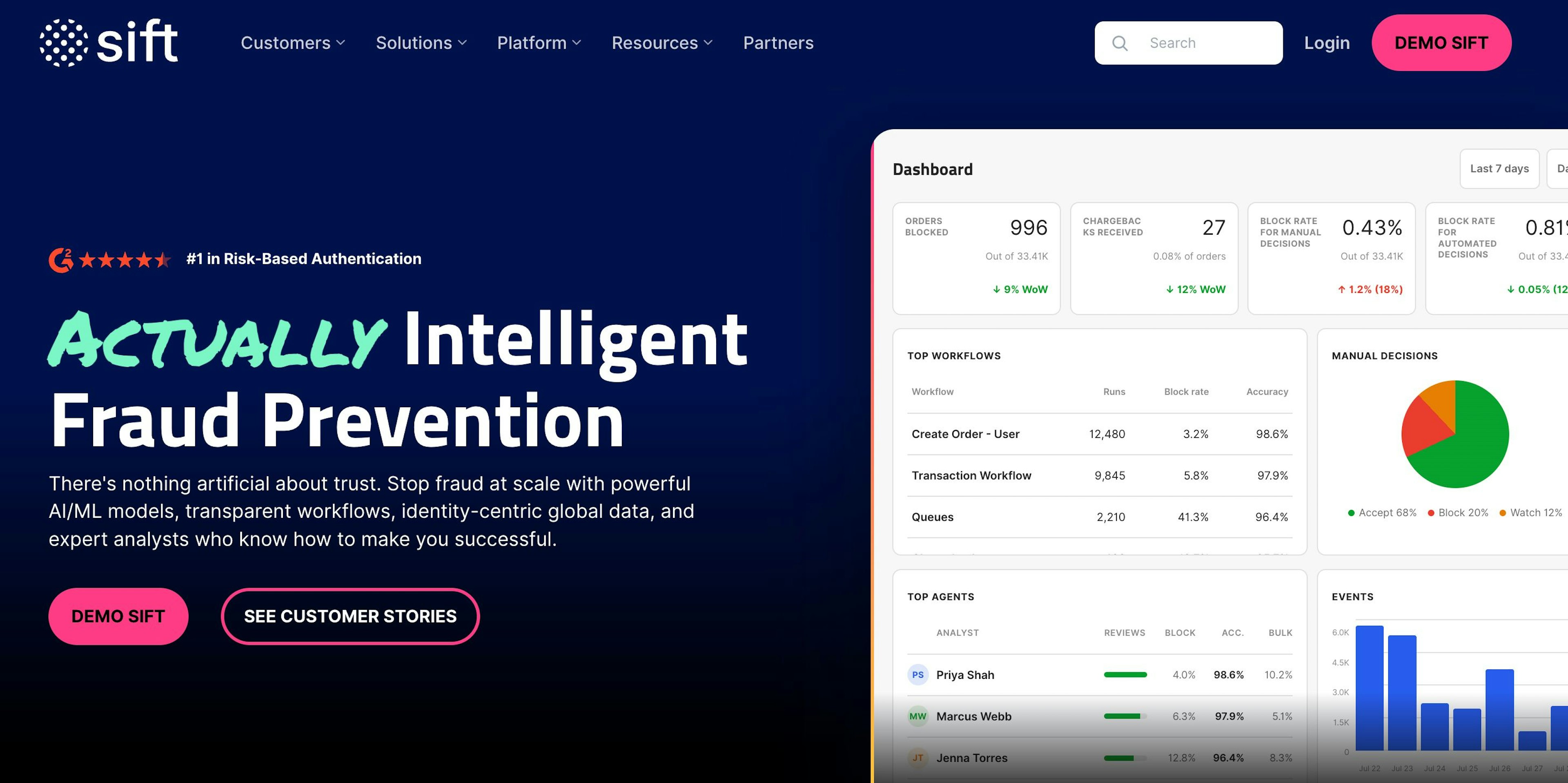
A digital trust and safety platform combining identity-level decisioning with real-time machine learning across signups, logins, and transactions, drawing on a large cross-merchant data network. Commonly associated with account takeover, payment risk, and first-party abuse.
Uses a global identity trust network to assess risk at checkout, pairing machine learning with customizable rules. Decisioning runs across online, mobile, and offline channels, with policy controls aimed at teams that manage fraud rules in-house.
8. Forter

Identity-based decisioning that evaluates each interaction instantly, with an emphasis on recognizing trusted customers to reduce unnecessary friction. Built for high-speed checkout and account-level decisions at global scale, with abuse prevention and dispute automation.
This category reads the session environment – the device, the connection, and how the user behaves. It can provide risk signals earlier in the customer journey, before a payment transaction or chargeback occurs. It is often adopted as a complement to the categories above rather than a replacement.
9. JuicyScore
A device and behavioral intelligence solution built around the pre-transaction session. JuicyScore collects 65,000+ non-personal signals and returns a vector of 250+ parameters across device, connection, and behavioral patterns, without relying on direct user identifiers such as names, phone numbers, or email addresses. For online merchants, the signals apply to new-account fraud, bonus and promotion abuse, account takeover at login and account recovery, and multi-accounting across sessions. It covers signal categories not always found in standard fingerprinting stacks, including VM and emulator detection, DOM injection, and remote access tool detection.
10. Fingerprint
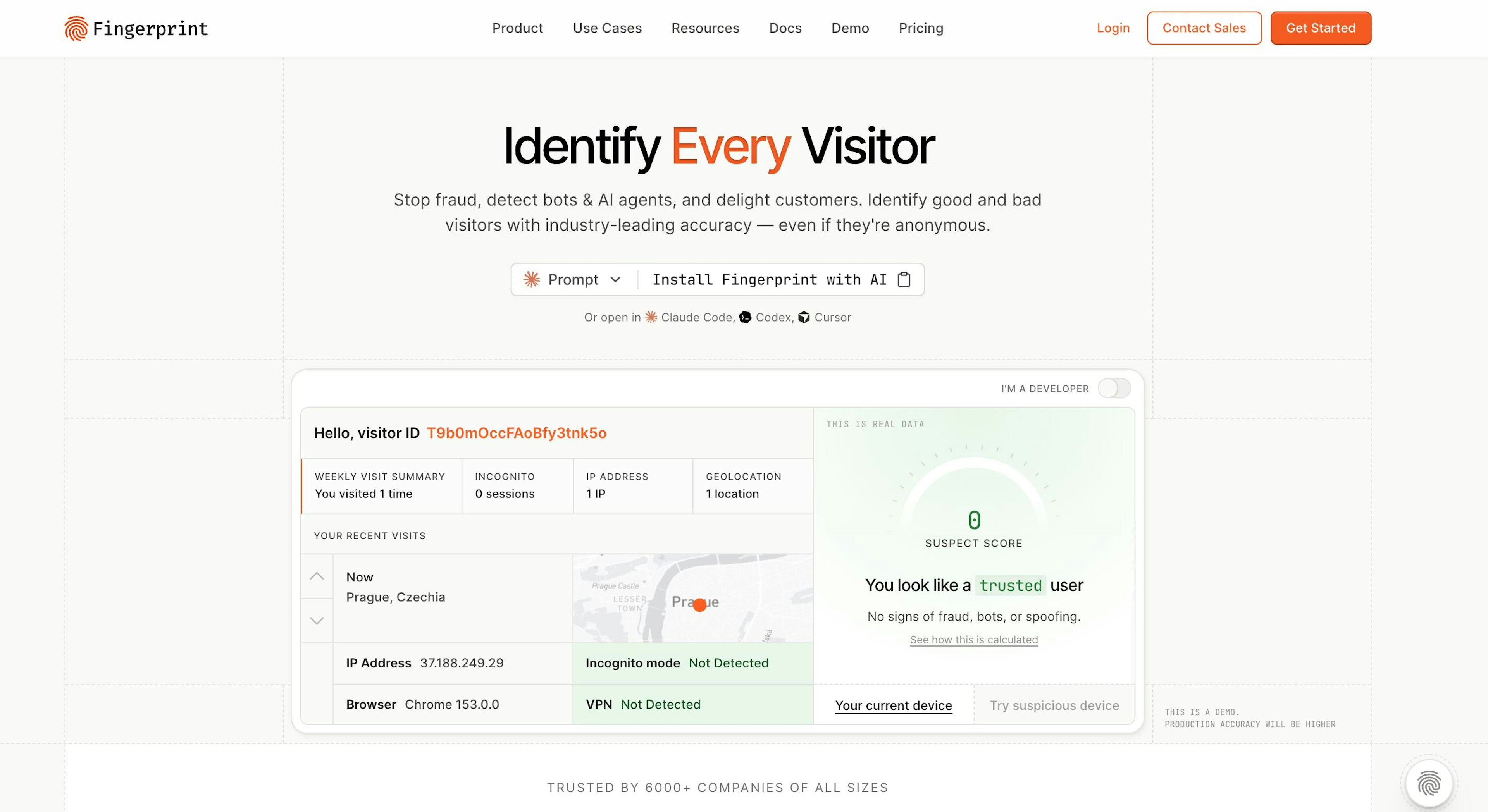
A developer-first device identification tool that assigns a persistent visitor ID from 100+ browser, network, and device signals, recognizing returning visitors even after cookies are cleared or networks change. Its Smart Signals suite extends into bot, VPN, proxy, incognito, and emulator detection.
11. SEON
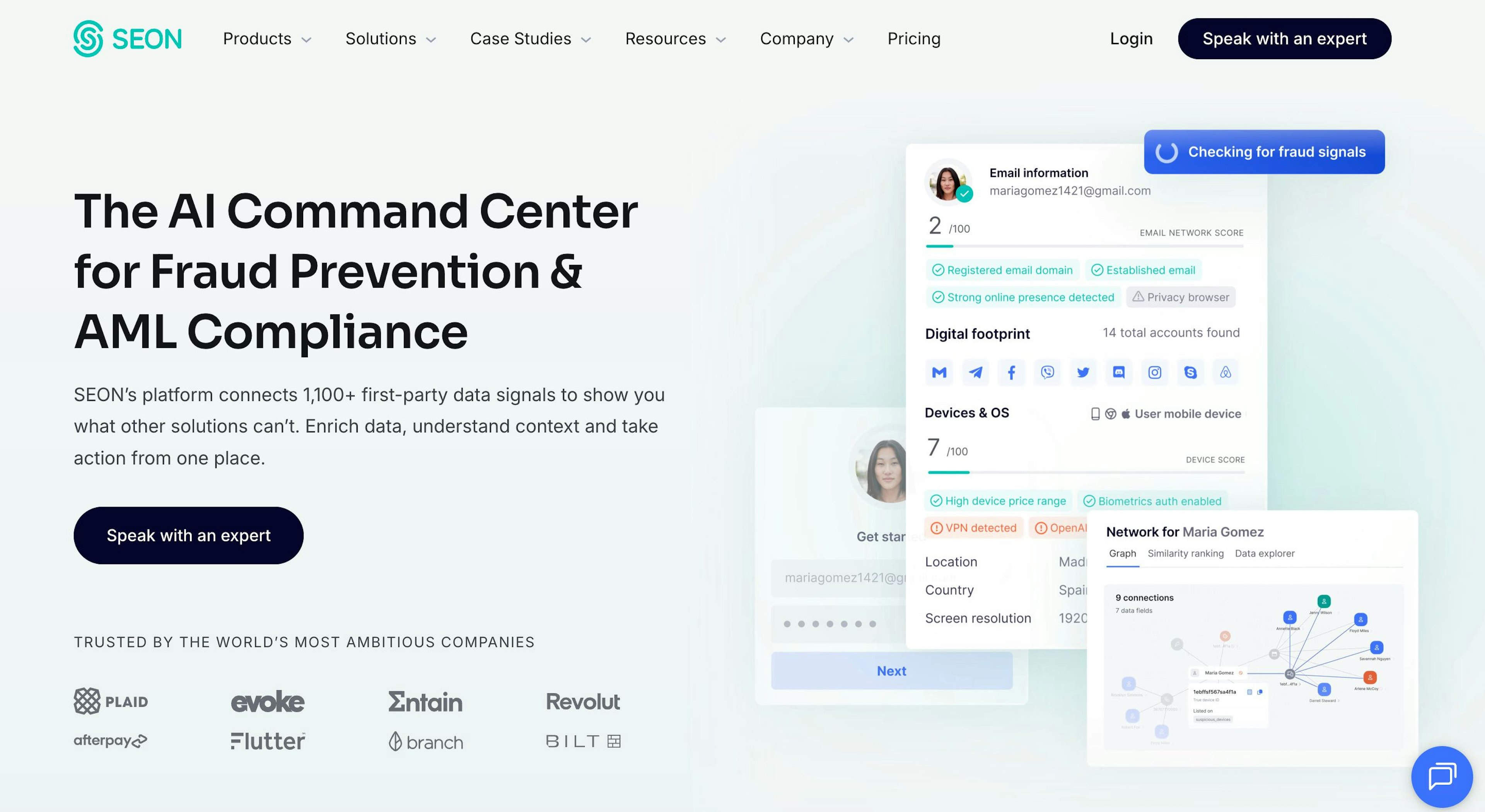
Combines device fingerprinting with digital-footprint enrichment – email, phone, and IP signals – plus a configurable rules layer and machine-learning scoring. API-first with fast integration, transparent public pricing, and auditable decisioning.
12. Sardine
Extends device fingerprinting with location and network-level context and a confidence score, aiming to reduce the identity collisions and divisions that pure fingerprinting can produce. Pairs device intelligence with behavioral biometrics and AML screening.
13. SHIELD
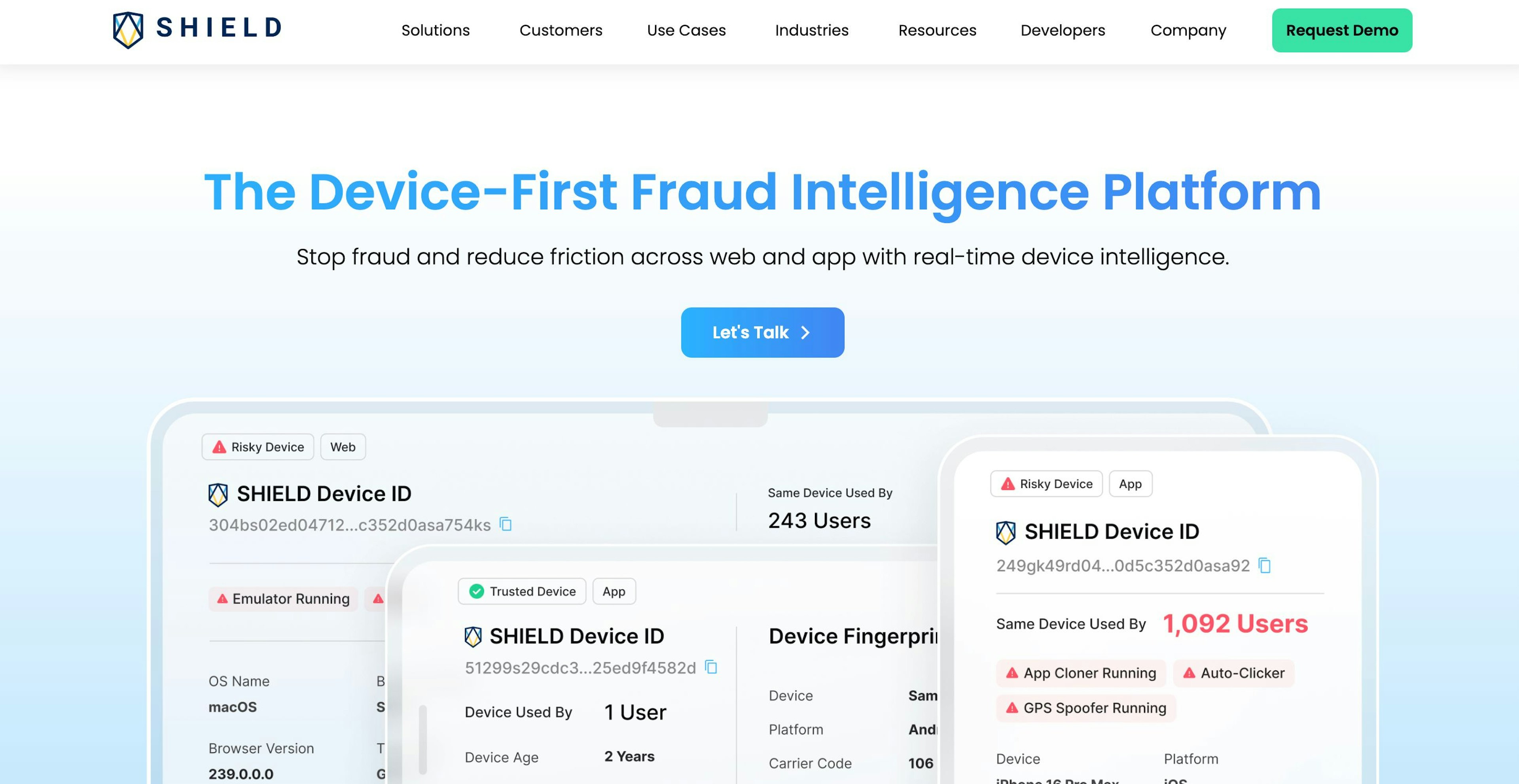
A Singapore-headquartered, mobile-first device intelligence tool combining device ID with behavioral analytics to detect fraud on Android and iOS apps. Built around mobile-native fraud vectors – GPS spoofing, app cloning, root and jailbreak detection – with strong presence in Asia-Pacific.
These systems identify scripted activity – card testing, credential stuffing, fake-account creation – that rarely triggers standard fraud rules. It's the most specialized category here, usually added to address a specific automation problem. See our guide to bot mitigation for how these defenses work in practice.
14. Arkose Labs

Stops automated and human-driven abuse through adaptive step-up challenges combined with device intelligence, particularly effective against bot attacks, fake account creation, and credential stuffing at scale.
| Provider | Primary approach | Key inputs / capabilities | Typical use case |
|---|---|---|---|
| Signifyd | Chargeback guarantee | Transaction, order, network, identity | Chargeback protection at scale |
| Riskified | Chargeback guarantee | AI, device, behavioral, order data | Enterprise approval optimization |
| ClearSale (Experian) | Hybrid fraud decisioning | AI + analyst review | Hybrid human review, false-decline reduction |
| Wyllo | Chargeback & post-purchase | Checkout + post-purchase / returns signals | Small–mid stores, checkout-to-returns |
| Bureau ID | Transaction & decisioning | Device, identity, behavioral, network, transaction | Unified cross-journey decisioning |
| Sift | Fraud & abuse decisioning | Behavioral + network, user-action level | Marketplaces, abuse beyond payments |
| Kount | Transaction & decisioning | Identity trust network, device, transaction | Omnichannel retailers |
| Forter | Transaction & decisioning | Identity graph, behavioral, transaction | Enterprise, approval optimization |
| JuicyScore | Device & behavioral intelligence | 65,000+ non-personal signals; vector of 250+ device, connection and behavioral parameters; VM/emulator, DOM injection, remote-access detection; no direct user identifiers | Merchants and marketplaces |
| Fingerprint | Device & behavioral intelligence | 100+ device/browser/network signals; persistent visitor ID | Developer-led, high-volume merchants |
| SEON | Device & behavioral intelligence | Device + email/phone/IP digital footprint | SMB–mid-market, fake-account prevention |
| Sardine | Device & behavioral intelligence | Device, behavioral biometrics, AML | Payments fintechs, fraud + compliance in one |
| SHIELD | Device & behavioral intelligence | Mobile-native device + behavioral signals | Mobile-first merchants, APAC |
| Arkose Labs | Bot & automation detection | Adaptive challenges + device intelligence | Large-scale bot and fake-account abuse |
Disclaimer. This comparison is based solely on publicly available information, including vendors' official websites, product pages, documentation, and publicly available technical descriptions. All comparisons are made in good faith based on how each vendor describes its own functionality and how we describe our own product.
Product capabilities, positioning, and availability may change over time, and the most suitable solution will depend on your integration requirements, risk strategy, and specific use cases.
Information about the vendors included in this comparison is based on publicly available sources as of September 2026.
These tools are not interchangeable. The right starting point is not a shortlist of names but a clear read on where you actually lose money, since a chargeback-guarantee platform and a device-intelligence layer solve fundamentally different problems. Map your losses first, then match them to the category built for that problem.
As you compare categories, ask practical questions:
Does it detect fraud at the stages where you actually lose money? How much manual review will it need? Will it integrate with your commerce stack and payment providers? Does it reduce false declines, or block good customers alongside fraudsters?
A short proof-of-concept on your own traffic is the most reliable test.
JuicyScore is a device and behavioral intelligence solution that reads the session behind every order, login, and sign-up – helping online merchants and marketplaces separate genuine customers from fraudsters at checkout, onboarding, or account access, without relying on direct user identifiers. Book a demo to see how the signal layer fits alongside your existing fraud stack.
Original research, regional fraud and regulatory insights, production case studies, and product updates – no filler, just what's useful for risk, fraud, and credit teams. Subscribe →
There's no single best tool – the right choice depends on your biggest fraud cost, transaction volume, and existing systems. Chargeback-heavy merchants lean toward guarantee tools like Signifyd or Riskified; those fighting fake accounts and repeat offenders lean toward device and behavioral intelligence such as JuicyScore or Fingerprint. Match the category to where you actually lose money.
Fraud is detected at four points in the journey. Device and behavioral signals read the session before payment – the device, connection, and how the form is filled. Transaction monitoring scores the payment itself against order and identity data. Bot detection identifies scripted activity at signup and login. Chargeback analysis catches what the earlier layers missed. Most merchants run more than one, since each reads a different data layer.
Chargeback management and guarantee tools (Signifyd, Riskified, ClearSale, Wyllo), transaction monitoring and decisioning platforms (Bureau ID, Sift, Kount, Forter), device and behavioral intelligence solutions (JuicyScore, Fingerprint, SEON, Sardine, SHIELD), and bot detection specialists (Arkose Labs). The four groups solve different problems and are usually combined rather than chosen between.
Start by identifying where your fraud concentrates – checkout, account takeover, chargebacks, or bots – then shortlist the category that addresses it. Compare tools on journey coverage, which data layers they analyze, false-decline handling, integration effort, privacy practices, and pricing. A short proof-of-concept on your own traffic is the most reliable test.
Assess detection depth (which signals they read and whether they correlate them), false-positive rates, SDK and API integration effort, latency under peak load, certifications and data-handling practices, and total cost against your margins. Ask for evidence on your own data, not only aggregate case studies.
Chargeback fraud is addressed by chargeback management tools – Signifyd, Riskified, ClearSale, and Wyllo among them – some offering a guarantee that reimburses approved fraudulent orders. Device and behavioral intelligence and transaction monitoring also help by flagging risky sessions before the order clears. Many merchants pair pre-transaction detection with post-transaction chargeback management.
Fraud detection software scores risk and flags or blocks suspicious activity, leaving liability with the merchant. A chargeback guarantee goes further: the vendor reimburses approved orders that later prove fraudulent, shifting that financial liability off the merchant. Many merchants use both – detection to catch fraud early, a guarantee to cap the residual cost.
A 2026 guide to ecommerce fraud prevention: the fraud types that erode margin, the controls that work, and how to stop losses before checkout.


A practical comparison of 12 leading device intelligence solutions and platforms in 2026 – signal depth, privacy architecture, and vertical fit.
New account fraud explained: what it is, how to prevent it across major industries, and the signals that catch fraudulent sign-ups early.

Get a live session with our specialist who will show how your business can detect fraud attempts in real time.
Learn how unique device fingerprints help you link returning users and separate real customers from fraudsters.
Get insights into the main fraud tactics targeting your market — and see how to block them.
Phone:+971 50 371 9151
Email:sales@juicyscore.ai


Our dedicated experts will reach out to you promptly